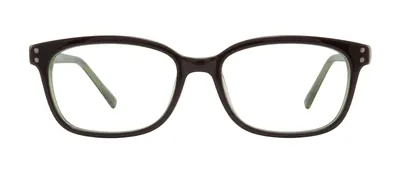
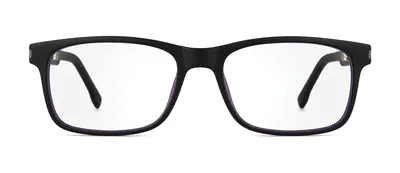
PD, or pupillary distance, is the distance between the centers of your pupils, measured in millimeters. The lab uses it to line up the optical center of each lens with your eyes. If it's off, your glasses can feel like they're "pulling" or give you eye strain.
Your PD is sometimes written on your prescription. If it isn't, you can measure it yourself.
What you need
- A mirror
- A ruler with millimeter markings (not just inches)
- Good light
- A friend, if you have one handy. It's easier with help, but you can do it alone.
The mirror method (by yourself)
- Stand about 8 inches (20 cm) from the mirror and look straight ahead.
- Hold the ruler flat against your brow, just above your eyes.
- Close your right eye. Line up the 0 mark with the center of your left pupil.
- Keep the ruler still. Close your left eye, open your right eye, and read the millimeter mark at the center of your right pupil.
- That number is your PD. Repeat three times and use the number you get most often.
The friend method
- Sit facing your friend at eye level, about arm's length apart.
- Look at a point over their shoulder, about 10 feet or more away. Looking at something far away gives you your distance PD.
- Your friend holds the ruler against your brow and reads from the center of one pupil to the center of the other.
Single PD vs. dual PD
A single PD is one number, like 63. A dual PD is two numbers, one for each eye measured from the center of your nose, like 31.5/31.5 or 31/32. Dual PD is a little more precise, especially if your face isn't perfectly symmetrical, which most aren't. At checkout you can enter either one.
To measure a dual PD, use the same mirror method but measure from the center of your nose bridge to each pupil separately.
What's a normal PD?
- Most adults: 54 to 74 mm, with many people around 60 to 66.
- Kids: usually 43 to 58 mm, depending on age.
If your number lands far outside those ranges, measure again. Our checkout will flag a PD that looks unusual so you can double-check.
Common mistakes
- Using an inch ruler. PD is always in millimeters.
- Moving the ruler between eyes. Keep it still against your brow.
- Looking at the ruler instead of straight ahead. Your pupils move when you look down.
- Measuring once. Take three readings.
What about near PD?
When you read, your eyes turn inward slightly, so your near PD is usually about 3 mm smaller than your distance PD. For single vision distance glasses, use your distance PD. If you're ordering single vision reading glasses, mention that in the notes at checkout.
Got your number? Pick a frame from our men's, women's or kids' collections. Every pair is $79 with single vision prescription lenses.