Lens technology, clearly explained
Blue Light vs Anti-Glare Glasses: The Technology Explained
Searching for “anti blue glare” glasses? The useful starting point is separating lens reflections from blue-light filtering. Here is how the technologies work, what they can reasonably claim and what is actually in our lens menu.
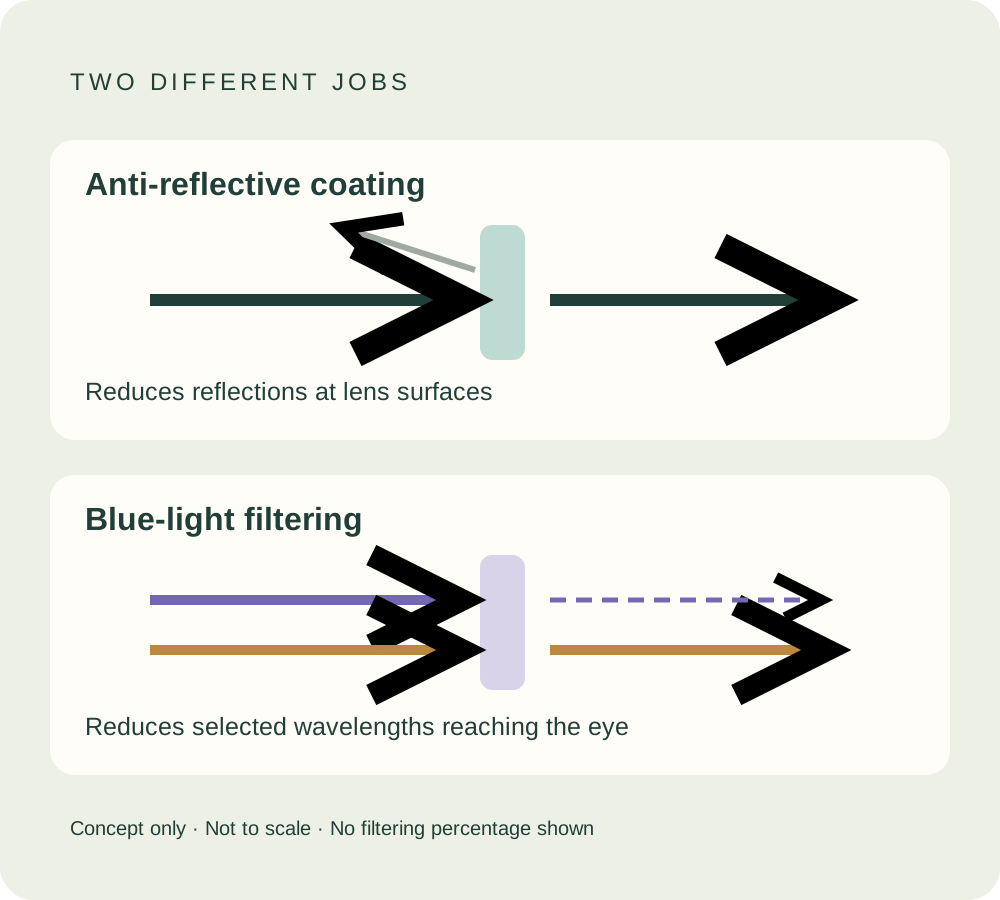
First, separate three different jobs
“Anti blue glare” mixes terms that describe different lens features. Your prescription controls the correction supplied for the intended viewing task. An anti-reflective coating addresses reflections from the lens surfaces. A blue-light filter changes how much of selected wavelengths passes through the lens.
One product can combine features, but the name of one feature does not establish the others. Ask for the exact lens and coating specification rather than assuming every “computer” or “anti-glare” pair contains a blue-light filter.
| Feature | What it addresses | What it does not establish |
|---|---|---|
| Prescription / lens design | Correction for a prescribed task or distance | Automatic suitability for every screen, book and driving task |
| Anti-reflective (AR) | Reflections at lens surfaces | Blue-light filtering, anti-fog performance or zero reflections |
| Blue-light filtering | Transmission of selected wavelengths | Proven prevention of screen eye strain, eye disease or sleep problems |
How anti-reflective coating works: light waves and thin films
Light can reflect wherever it meets a boundary between optical materials. A carefully designed thin coating changes how reflected light waves line up. Under suitable conditions, waves reflected from different boundaries partially cancel instead of reinforcing each other. Physicists call this destructive interference.
Thickness, refractive index, wavelength and angle matter. A coating optimized for one condition is not a promise of complete cancellation for all light. This is why “anti-reflective” should mean reduced surface reflection, not an invisible lens in every photograph. OpenStax explains the underlying thin-film physics.
For a buyer, the practical question is whether the specified coating addresses the reflections you notice on the lenses. It does not remove the need to consider a lamp, window or video-call light that is shining directly into the setup.
How blue-light filtering works: coating or lens material
A blue-light filter selectively reduces transmission in part of the visible spectrum. Depending on the product, filtering can be implemented in a surface treatment or built into the lens material. Those are different technical approaches, so compare the actual product specification.
ZEISS describes both a selective blue-violet coating and filtering incorporated within a lens structure. These are examples of technology categories, not products represented as available in Fast Eyeglasses checkout. See the manufacturer’s technology descriptions.
If someone quotes a filtering percentage, ask which wavelength range and test conditions it describes. A percentage without that context is not a useful complete comparison, and an optical filtering measurement is not proof of a clinical benefit.
Does a blue or purple reflection prove blue-light filtering?
No. A visible reflection color is not enough to identify a lens’s full specification. ZEISS describes a bluish residual reflection in an anti-reflective coating; that shows why color alone is a poor shortcut for deciding what a lens does. Its coating guide discusses residual reflections.
Ask for the named coating and its documentation. A phone photograph, a colored reflection under a shop light or a home demonstration cannot establish a measured filtering curve or a health outcome. Do not shine intense light into your eyes to test glasses.
What does the evidence say about screen eye strain?
A 2023 Cochrane review included 17 randomized trials involving 619 adults. It found that blue-light-filtering lenses may provide no short-term advantage for computer-related eye strain compared with non-filtering lenses. Findings about sleep were uncertain, and the included trials did not establish benefits for macular health. The review searched studies through March 2022; it is evidence with limits, not a test of every product sold today. Read the review and its limitations.
That distinction matters: a filter can alter transmitted light without having a proven benefit for the symptom in an advertisement. Do not treat “filters blue light” as equivalent to “prevents headaches,” “protects the retina from screens” or “guarantees better sleep.”
Start a screen-work check with the actual setup
Record the normal screen position, reading tasks and lighting before shopping. Prevent Blindness recommends regular breaks, blinking, reducing surrounding glare and positioning the screen appropriately. Its guidance also advises an eye examination for continuing problems. Read its digital-device guidance.
Describe the task to an eye-care professional rather than guessing a stronger prescription. A reading prescription and a screen-distance prescription should not be assumed interchangeable. Persistent discomfort or a change in vision deserves individual assessment, not another coating selected as a diagnosis.
What Fast Eyeglasses actually offers
Our current online coating choices are standard anti-glare for +$35 and Crizal Easy anti-glare for +$50. There is no separately labeled blue-light-filter upgrade in the current lens menu. We do not describe either anti-glare choice as a verified blue-light-filter product.
With the everyday $79 complete-pair base and no other paid upgrades, those choices produce starting configurations of $114 or $129. Prescription-strength charges and other selected options are additional. Compare the actual configuration in the glasses cost calculator and check the current lens menu before ordering.
Crizal is a family of products: features advertised for a differently named version are not automatically included in the option called Crizal Easy at checkout. Ask us to confirm the exact supplied specification if a particular feature matters.
Five questions before paying for lens technology
- What exact lens and coating am I buying?
- Is the claim about surface reflections, wavelength filtering or a measured health outcome?
- Does the prescription suit the task for which I need the pair?
- What is the complete price, including selected upgrades and any strength charges?
- What care instructions, warranty and custom-order terms apply?
A clear answer is more useful than a dramatic technology label. Choose the feature for a specific purpose, and keep the physical behavior of a lens separate from what clinical research can demonstrate.
Choose for your actual day
Compare the pair, the options and the complete price.
Fast Eyeglasses supplies corrective single-vision pairs and ships free to Michigan, Oregon, Montana and Delaware only. Start with your prescription and frame measurements, then decide whether an anti-glare upgrade fits your priorities.
Explore frames and lens options · Compare complete prices
Planning two pairs? Read the COUPON20 terms.
With at least two complete pairs in the same order, save 20% on one lowest-priced eligible complete pair, including selected upgrades but excluding prescription-strength charges. Savings apply automatically; the code does not add another discount, and Fast Cash does not stack. Current checkout uses one prescription per order. Contact us first for different prescriptions or wearers.
Custom glasses are final sale for change of mind, customer-selected fit and entered prescription/PD errors; published remedies apply to qualifying lab errors, defects and shipping damage. Full offer terms · Return policy
Common questions
Are anti-glare glasses the same as blue-light glasses?
No. Anti-reflective treatment reduces surface reflections; blue-light filtering reduces transmission in selected wavelengths. A product may combine features, but confirm the exact specification.
Does a blue reflection prove my glasses filter blue light?
No. Residual reflection color alone does not identify the filtering specification. Ask for the named lens and coating documentation.
Does Fast Eyeglasses sell a blue-light upgrade online?
There is no separately labeled blue-light-filter upgrade in the current online lens menu. Standard anti-glare and Crizal Easy are the listed anti-glare choices.
Will either feature guarantee no screen eye strain?
No. A coating is not a diagnosis or a guaranteed treatment. Consider the actual prescription and setup, and seek individual assessment for continuing problems.
About the sources
Technology explanations cite the manufacturer for product mechanisms and OpenStax for thin-film physics. Clinical conclusions cite the Cochrane review, with its study dates and limits stated above. Screen-use guidance comes from Prevent Blindness. Links were checked October 20, 2026. This retailer article does not imply endorsement by those organizations or individual medical advice.